

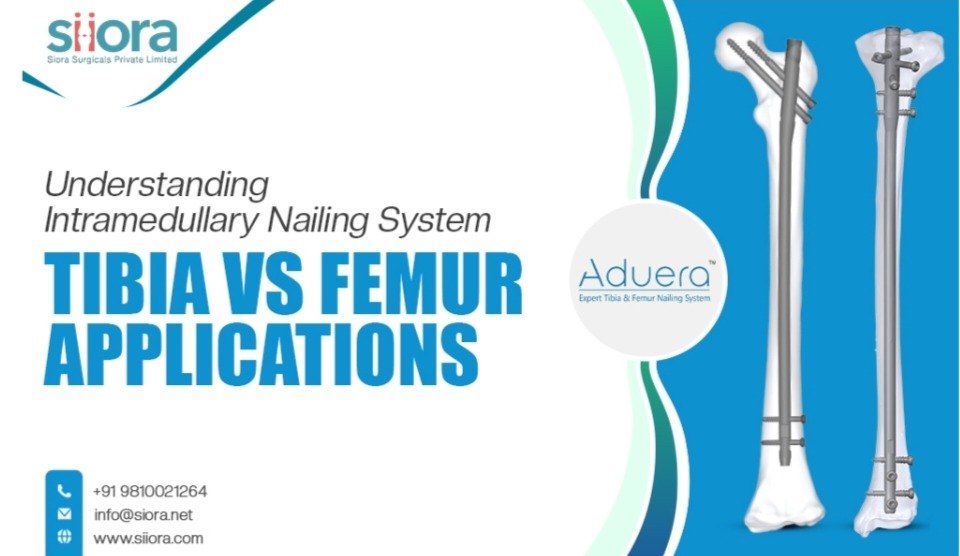
Intramedullary nailing is one of those innovations in orthopedics that quietly changed everything. Surgeons had plates and external fixators for years, but the idea of stabilizing a broken bone from the inside—right through its natural canal—brought a level of stability that was hard to match. Even so, the tibia intramedullary nail and those designed for the femur are not interchangeable. Each bone brings its own challenges, and the implants have evolved accordingly.
Why These Nails Became Essential in Trauma Care?
Both the tibia and femur carry the body in ways we barely notice—until one of them breaks. These fractures make everyday activities suddenly impossible, so surgeons aim for a fixation method that supports early movement and reduces additional tissue damage. That’s where intramedullary nails work so well. They sit deep inside the bone, aligned with the natural load-bearing axis, and they do their job without the need for large incisions.
But despite their shared purpose, the systems used for tibia and femur fractures are shaped by different anatomical realities. What works beautifully in the femur can be completely unsuitable for the tibia.
Tibia Nails: Built for Accuracy in a Tricky Bone
The tibia looks straightforward on the outside, but anyone who has tried to align a fractured one knows the story is different. Because so much of the bone lies right under the skin, even a small misalignment becomes noticeable. Plus, the canal isn’t perfectly straight, and distal fractures tend to drift if the fixation isn’t precise.
Modern tibial nailing systems have features that reflect decades of lessons:
- Several locking hole options, especially near the distal end, to manage fractures that sit close to the ankle.
- A natural bend in the nail to follow the tibial curve.
- Support for maintaining rotation and length—even in fractures with a lot of fragmentation.
Patients with tibial fractures often struggle the most with alignment. So implant designers put a lot of effort into helping surgeons avoid valgus or rotational deformity. A well-placed tibial nail can make early weight-bearing possible, which is a relief for most patients.
Femoral Nails: Engineered for Strength Above All
The femur is a different beast altogether. It’s thicker, deeper, and wrapped in strong muscle groups that pull in different directions when it fractures. Add to that the tremendous loads the bone carries—even while standing—and the fixation system has to be significantly more robust than what’s used in the tibia.
Femoral nails typically include:
- A larger, stronger nail body to resist bending.
- Options for antegrade or retrograde insertion depending on the fracture pattern and patient condition.
- Locking screws that can manage both rotation and axial compression, which is especially important in weight-bearing recovery.
Tibia vs Femur Nails: How They Truly Differ?
When comparing the two systems, the distinctions become obvious:
- Mechanical demands: Femoral nails need to withstand enormous forces, while tibial nails emphasize precision.
- Entry points: Generally, the tibia has a single entry point, but the femur allows two approaches with their own benefits.
- Locking strategies: Tibial nails rely heavily on multi-directional locking to prevent drift. Femoral nails use powerful proximal locking to manage high-load healing.
- Surgical goals: Tibia fractures often revolve around maintaining alignment; femur fractures revolve around stability.
In Closing
Although both types of intramedullary nails follow the same basic concept, their design and use reflect two completely different challenges. Tibial nails favor accuracy and control, while femoral nails prioritize strength and flexibility in approach. As the trauma implant designs continue to evolve, surgeons gain more reliable tools—and patients gain a smoother path back to walking, working, and living normally.